
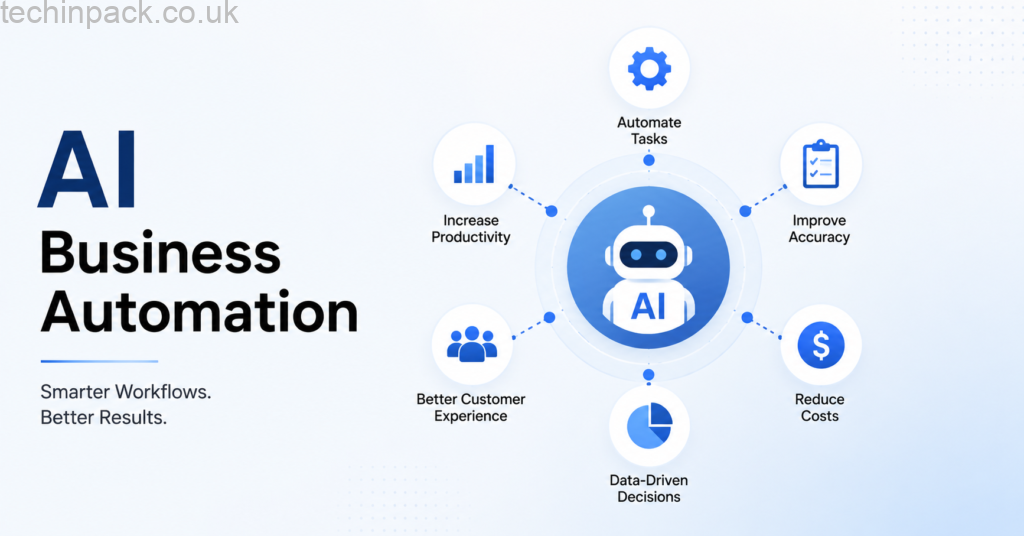
AI business automation is one of the most searched topics in digital transformation today because companies are actively looking for ways to automate workflows, reduce operational costs, and improve overall productivity using technologies such as machine learning, robotic process automation (RPA), and AI agents.
However, there is a major gap in most available online content. While the majority of articles focus on surface-level benefits like efficiency gains, faster workflows, cost reduction, and the future potential of automation, they often fail to explain what actually happens when these systems are implemented in real business environments. In reality, AI automation is far more complex than it appears in theory, and businesses frequently encounter hidden challenges such as integration failures, workflow breakdowns, data quality issues, unexpected costs, and the need for continuous human supervision to keep systems running correctly.
Real Problem AI Automation Fails Quietly in Real Businesses
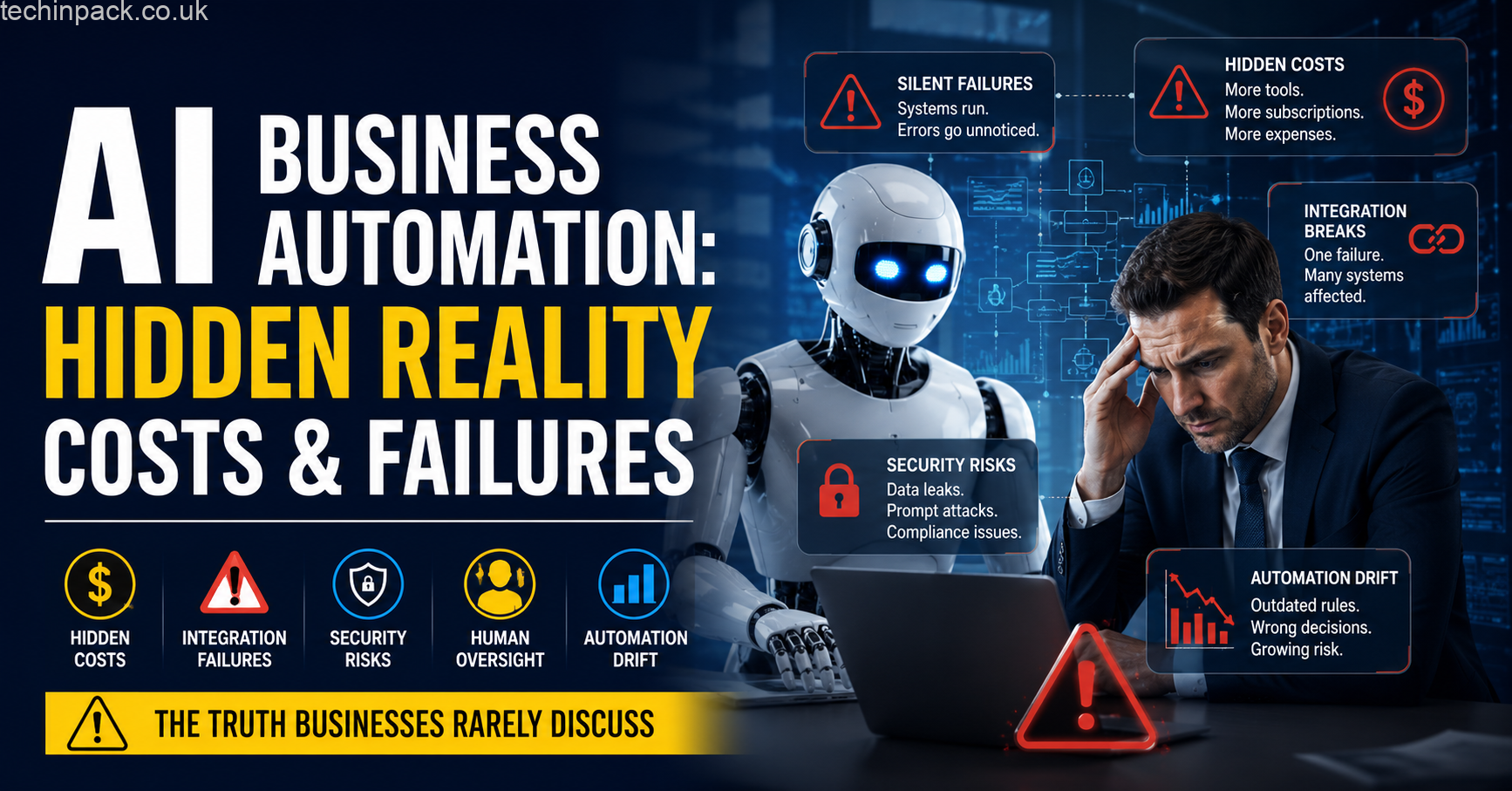
Most companies assume that AI automation fails in an obvious way, such as system crashes, error messages, or visible breakdowns in workflows. However, in real-world business environments, AI systems often fail silently, which makes the problem far more dangerous. Silent failure means that the automation continues to run without interruption, but the outputs it produces are incorrect or unreliable.
Data may be processed wrongly without triggering any alerts, and decisions may be made using outdated, incomplete, or inaccurate information. Over time, these small errors can spread across connected systems and gradually damage overall business accuracy. For example, an AI-powered invoice processing system might incorrectly classify a small percentage of invoices, such as 5%, but since the system continues operating normally, the issue may go unnoticed. As a result, financial reports slowly become inaccurate, even though everything appears to be functioning correctly.
Hidden Costs of AI Business Automation
Most articles say AI automation reduces costs. That is only half true.real hidden costs include:
API and Usage Costs
One of the most overlooked expenses in AI business automation is the cost associated with API usage. Most AI platforms charge businesses based on the number of API requests, token consumption, and the volume of data processed through their systems. While these costs may seem manageable during the testing phase, they can increase rapidly as automation expands across departments and handles larger workloads. Businesses often underestimate how frequently automated workflows interact with AI models, resulting in monthly expenses that grow much faster than expected.
Tool Subscription Stacking
Modern AI automation rarely relies on a single platform. Instead, businesses typically combine multiple tools such as Make, Zapier, n8n, CRM systems, AI APIs, analytics platforms, and project management software to create complete automation workflows. Although each tool may seem affordable on its own, the combined cost of multiple subscriptions can quickly add up.
Maintenance Costs
Many businesses assume that once an AI automation system is deployed, it will continue operating indefinitely without additional effort. In reality, AI automation requires ongoing maintenance to remain effective and accurate. Workflows must be monitored regularly, bugs need to be identified and fixed, prompts often require optimization, and integrations must be updated whenever connected applications change. Business processes also evolve over time, which means automation systems need continuous adjustments to stay aligned with organizational goals.
Human Oversight Costs
Despite advances in artificial intelligence, human oversight remains an essential part of successful automation. Employees still need to review AI-generated outputs, verify the accuracy of automated decisions, correct mistakes, and handle unusual situations that fall outside predefined workflows. In many cases, organizations must assign staff specifically to monitor automated systems and ensure they operate correctly.
Integration Problem Why AI Automation Breaks in Real Systems
One of the biggest challenges in AI business automation is integration failure. Many businesses still rely on legacy ERP systems, outdated CRM platforms, and non-standard databases that do not easily connect with modern AI tools.
In addition, most automation workflows depend on multiple APIs to exchange data between systems, meaning a single API failure can disrupt an entire process. As companies connect AI platforms with email tools, analytics software, CRM systems, and RPA solutions, the automation environment becomes increasingly complex and fragile. The result is that even a small change, software update, or data mismatch can break workflows, stop data synchronization, and reduce the overall reliability of the automation system.
Automation Does NOT Mean Intelligence
Most businesses assume that AI automation works because it can generate responses, classify data, and process information at high speed. This creates the misconception that AI understands business operations in the same way humans do. In reality, AI does not think, reason, or understand business objectives. It simply identifies patterns in data, predicts likely outcomes, classifies information, and generates outputs based on its training.
AI cannot understand company strategy, take responsibility for decisions, exercise human judgment, or effectively manage unexpected real-world situations. While AI excels at executing repetitive and data-driven tasks, humans remain responsible for decision-making, risk assessment, and strategic direction.
Workflow Fragility Why Automation Breaks Easily
- AI automation performs best in controlled environments, but real-world business conditions are constantly changing.
- Small input changes can break automated workflows without obvious warning signs.
- Changes in document, email, or data formats may cause AI systems to produce incorrect outputs.
- Unexpected or incomplete data often leads to processing errors and inaccurate decisions.
- Edge cases are frequently overlooked during automation design, creating workflow gaps.
- Many AI automations lack fallback mechanisms, making recovery difficult when failures occur.
- Errors can spread across connected systems, affecting multiple departments and processes.
Automation Drift Long Term Problem
One of the most overlooked challenges in AI business automation is automation drift, a gradual decline in system effectiveness that occurs as business environments change over time. While an AI automation system may continue operating without technical issues, its accuracy and business value can slowly decrease as customer behaviour, market conditions, data patterns, and operational rules evolve.
For example, a fraud detection model trained in 2024 may become significantly less effective by 2026 because fraud tactics have changed, transaction patterns have shifted, and the model has not been retrained with updated data. As a result, the system remains technically functional but begins making inaccurate business decisions, creating hidden risks that are difficult to detect.
Responsibility Problem Who is Accountable for AI Mistakes?
| Aspect | Reality in AI Automation |
| Who makes the decision? | AI may recommend or automate actions, but the business ultimately owns the decision. |
| Who is legally responsible for mistakes? | The business or organisation deploying the AI system is typically responsible. |
| Are AI vendors accountable? | Generally, AI vendors provide the technology but are not responsible for how businesses use it. |
| Are developers legally liable? | Developers usually build and maintain the system, but legal responsibility remains with the organisation using it. |
| Main compliance risk | AI-generated errors can lead to regulatory violations, financial penalties, or incorrect business actions. |
| Audit challenge | Automated decisions can be difficult to trace, explain, and justify during audits. |
| Legal uncertainty | Many AI regulations are still evolving, creating uncertainty around liability and governance. |
| Best risk mitigation strategy | Implement human review, approval workflows, and ongoing monitoring of AI outputs. |
| Role of Human-in-the-Loop (HITL) | Humans validate critical decisions, handle exceptions, and ensure accountability. |
| Key takeaway | AI can automate tasks, but responsibility, compliance, and accountability always remain with humans and the business. |
Over-Automation Risk When AI Becomes a Problem
One of the most common misconceptions about AI business automation is that increasing automation always leads to better results. In reality, over-automation can create new operational challenges by reducing flexibility, limiting human oversight, and making business processes more rigid. While automation is highly effective for repetitive and rule-based tasks, it often struggles with situations that require empathy, judgment, or contextual understanding.
For example, a fully automated customer service system may efficiently handle routine inquiries but fail to resolve complex or emotionally sensitive customer complaints. As organisations automate more processes, making changes, correcting errors, or adapting to new business requirements can become increasingly difficult.
Security Risks in AI Automation Systems
One of the most overlooked aspects of AI business automation is security. While most articles focus on productivity and efficiency, they rarely explain the risks that emerge when AI systems are connected to multiple business applications and data sources.
AI-powered workflows can expose sensitive information through data leakage, especially when customer, financial, or operational data moves across different platforms. Another growing threat is prompt injection attacks, where malicious users manipulate AI inputs to reveal confidential information or alter system behaviour.
ROI Reality Why AI Automation Does NOT Pay Off Immediately
AI automation introduces a serious legal and operational problem that most articles ignore: responsibility ambiguity. If an AI system makes a wrong decision—such as approving a fraudulent transaction, misrouting a customer request, or generating incorrect financial data it is not the AI that is held accountable. In real-world practice, businesses carry full legal responsibility, while AI vendors and developers are typically not liable for downstream consequences.
This creates a complex risk environment involving compliance challenges, audit difficulties, and unclear ownership of decision-making. As a result, organisations cannot fully “delegate” accountability to automation systems. This is why human-in-the-loop supervision remains essential, ensuring that critical decisions are reviewed, validated, and legally owned by human operators rather than autonomous systems.
Human Role Evolution: What Actually Changes
AI automation does not eliminate humans; it transforms their roles instead. Rather than replacing people entirely, AI shifts human responsibility away from routine execution and towards higher-level supervision and control.
In this new landscape, humans take on critical tasks such as monitoring AI systems to ensure accuracy and reliability, managing automated workflows, handling exceptions that require human judgement, improving data quality to enhance model performance, and overseeing important decisions before they are finalised. In essence, the role of humans evolves from execution-based work to supervision-based work, where strategic thinking, oversight, and intervention become far more valuable than manual task completion.
Conclusion
AI business automation is not simply a productivity tool; it is better understood as a system-wide transformation layer that reshapes how organisations operate at a structural level. While it can significantly improve efficiency and speed, the reality is that it is neither fully autonomous nor something that can be safely deployed as a “set and forget” solution. It also does not remove the need for human involvement.
Instead, AI automation shifts complexity into new areas, introduces hidden operational and data-related risks, and demands ongoing monitoring and governance.