
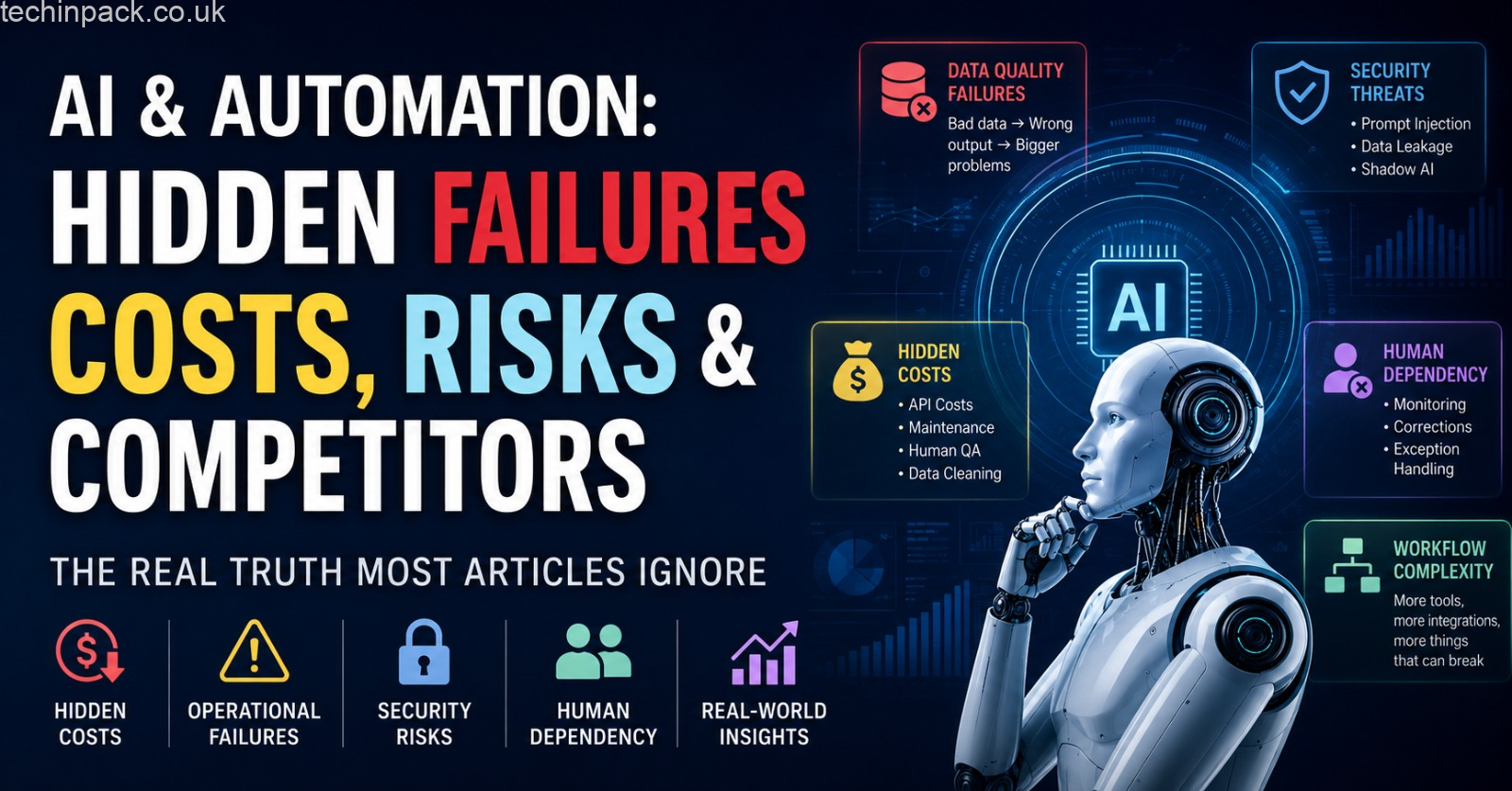
AI automation is one of the most talked-about topics in business technology, but most explanations online are incomplete. They either focus too much on theory, vendor tools, or unrealistic “fully automated future” claims.
In reality, AI automation is not just about efficiency it is a complex operational system that creates new risks, hidden costs, workflow shifts, and human dependency patterns that many articles completely ignore.What’s often missing is how these systems behave under real business pressure, where data is messy, exceptions are constant, and tools rarely work as smoothly as promised. This gap between theory and execution is where most automation projects either succeed partially or fail silently over time.
What AI Automation Really Means
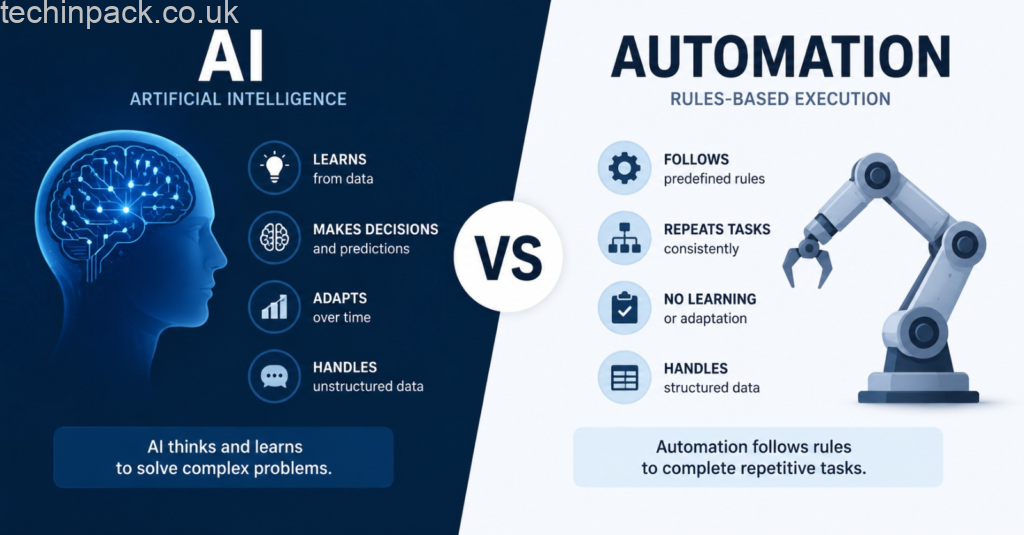
AI automation is the use of artificial intelligence to execute business tasks and connect them into workflows that run with minimal human intervention. But in real operations, it is better defined as a semi-autonomous workflow system where AI handles interpretation and decision support, while humans remain responsible for oversight, correction, and exception handling. Most systems today are not fully autonomous; instead, they operate in a hybrid model where AI reads and interprets data, suggests or decides actions, automation tools execute those actions, and humans supervise edge cases and failures.
In practice, this means AI automation is less about removing human involvement and more about redistributing it into monitoring, validation, and decision checkpoints across the workflow. This is the most important truth missing from most online explanations: AI automation is not “hands-free”; it shifts work from one place to another.
Biggest Hidden Reality AI & Automation
| Work Type | What It Means | Real-World Example |
| Monitoring Work | Constantly tracking AI outputs, workflows, and system behaviour to ensure everything is running correctly. | Checking dashboards, reviewing logs, monitoring failed automation runs, tracking AI accuracy over time. |
| Correction Work | Fixing mistakes made by AI instead of performing the original task manually. | Editing AI-generated emails, correcting wrong classifications, rewriting inaccurate summaries or outputs. |
| Exception Handling Work | Managing cases the AI cannot handle properly, usually complex or unusual scenarios. | Handling unusual customer complaints, resolving edge-case errors, manually approving flagged transactions. |
Why Most AI Automation Projects Fail in Real Businesses
One of the most missing topics in competitor content is failure mechanics. AI automation does not fail because “AI is weak”—it fails due to system design and operational gaps.
Silent Failure Problem (Most Dangerous Issue)
One of the most dangerous issues in AI automation is silent failure, where systems continue operating without showing obvious error signals. In such cases, wrong classifications, incorrect routing, or flawed outputs can persist at scale without immediate detection. Because everything appears “normal” on the surface, businesses often remain unaware of the issue until the impact becomes significant, leading to operational losses, poor customer experiences, or corrupted decision flows.
API Dependency Collapse
AI automation systems heavily depend on external APIs and third-party services such as OpenAI, Claude, CRM platforms, and workflow tools. If any of these services change their structure, pricing, or availability, the connected automation workflows can break instantly. This creates a fragile dependency chain where a single external update or outage can disrupt entire business processes, making the system far less stable than it initially appears.
Over-Automation Design Mistake
A common mistake in AI automation design is over-automating too many steps without proper structure, fallback logic, or human oversight. When systems are built this way, even minor errors can cascade and break the entire workflow. Instead of increasing efficiency, over-automation often makes systems rigid and fragile, where the lack of flexibility leads to complete process failure when unexpected inputs occur.
Data Reality Gap
Another major challenge is the gap between how AI assumes data is structured and how business data actually exists in reality. AI models train on clean and structured datasets, but real-world business data is often messy, inconsistent, duplicated, or outdated. This mismatch leads to incorrect interpretations and flawed outputs, even when the underlying AI model is highly advanced and accurate.
Hidden Cost Structure of AI Automation
Most articles say AI reduces cost. In reality, cost shifts rather than disappears.
API Usage Cost Explosion
AI automation costs often increase rapidly with usage because pricing depends directly on consumption. As businesses expand automation, more workflows generate higher token usage, more users trigger additional API calls, and overall automation activity leads to exponential billing growth. Many companies underestimate this scaling effect, assuming costs will remain stable, when in reality usage-driven AI systems often become significantly more expensive over time.
Workflow Execution Costs
In addition to AI model costs, automation platforms themselves charge for scenario runs, operations, and integrations. As workflows scale across departments and processes, these execution costs accumulate continuously. Over time, automation shifts from a predictable fixed-cost tool into a usage-based financial system where every action, trigger, and integration contributes to ongoing operational expenses.
Human QA Cost
Even after organisations implement automation, humans still remain involved. Teams still verify AI outputs, correct errors, and ensure compliance with internal and regulatory standards. In many cases, this quality assurance layer becomes a hidden but essential cost centre, as human review maintains accuracy, trust, and reliability in automated decision-making systems.
Data Cleaning Cost
Before AI automation can function effectively, organizations must invest heavily in preparing their data. This includes structuring datasets, standardizing formats, removing duplicates, and correcting inconsistencies. In many real-world scenarios, the cost and effort of data cleaning exceed the price of the AI tools themselves, making it one of the most underestimated but critical components of successful automation.
Maintenance Cost
AI automation is not a “set and forget” system; it requires continuous maintenance to remain functional and accurate. Models may change behaviour over time, APIs get updated or deprecated, workflows break unexpectedly, and prompts often need to be rewritten or optimized. This creates an ongoing engineering and operational workload that businesses must account for to keep automation systems stable and effective.
Expectation vs Reality Gap in AI Automation
This is one of the most important missing SEO topics.
| Expectation | Reality |
| Fully autonomous system | Semi-autonomous workflows |
| No human involvement | Constant human supervision |
| Instant cost savings | Delayed ROI with high setup cost |
| Stable workflows | Frequent adjustments needed |
| One-time setup | Continuous optimization system |
Data Quality Failure Loop
Even advanced AI systems can fail significantly when the underlying data quality is poor. This creates a damaging feedback loop where bad data leads to incorrect AI interpretation, which then results in wrong automation actions, and those actions generate even messier data over time, further degrading system performance. As this cycle continues, it produces compounding errors, broken workflows, and increasingly unreliable decision-making systems that become harder to fix.
For example, if a CRM contains duplicate customer records, missing fields, or inconsistent labels, the AI may misclassify leads, send incorrect or irrelevant emails, and trigger the wrong workflows entirely. Over time, this does not just reduce efficiency—it actively damages the integrity of the entire automation system. While many competitors briefly mention that “data quality matters,” they often fail to explain this deeper feedback loop failure, which is one of the most critical reasons AI automation systems collapse in real-world environments.
Security Risks in AI Automation
AI automation systems face several serious security risks that are often underestimated in most discussions. One major issue is prompt injection attacks, where attackers manipulate AI inputs to trick the system into revealing sensitive information, bypassing safety rules, or overriding intended instructions. Another critical risk is data leakage through outputs, where AI unintentionally exposes confidential business logic, internal systems data, or customer information in generated responses, leading to privacy and compliance concerns.
Shadow AI usage is also becoming increasingly common, where employees use unauthorized AI tools outside official IT control, often uploading sensitive company data and creating hidden security vulnerabilities.
When You SHOULD NOT Use AI Automation
- AI automation is not suitable for every type of business process and can create more risk than value in certain scenarios.
- It should be avoided in high-risk decision environments such as legal rulings, medical diagnosis, and financial approvals where mistakes can have serious consequences.
- It is also not ideal for emotion-based decisions like HR disputes, sensitive customer complaints, or negotiations that require human empathy and judgement.
- AI automation performs poorly in highly unstable workflows where processes change frequently or inputs are unpredictable and inconsistent.
- It is inefficient for low-volume tasks, where the cost of automation is higher than simply doing the work manually.
- Core rule: If the consequences are high and the data is unstable, AI automation increases risk instead of improving efficiency.
AI Automation Maturity Model
- AI automation evolves in clear stages, starting from fully manual processes to advanced autonomous systems.
- Stage 1 Manual Work involves completely human-driven processes with no automation support.
- Stage 2 Rule-Based Automation (RPA) uses fixed “if-this-then-that” logic to handle repetitive tasks.
- Stage 3 AI-Assisted Automation introduces AI to support decisions, but humans still execute actions.
- Stage 4 Semi-Autonomous Workflows allow AI to perform most actions while humans only approve exceptions and edge cases.
- Stage 5 Agentic Automation represents advanced systems where AI can plan and execute multi-step tasks independently.
- In reality, most organizations today operate around Stage 3–4, and very few have reached fully autonomous Stage 5 systems.
Industry Reality Differences
AI automation performs very differently across industries, and these differences are often oversimplified in competitor content. In finance, it works best because data is highly structured, rules are clearly defined, and strong compliance frameworks already exist, which makes automation more predictable and reliable. In healthcare, results are only partially successful because data is often unstructured, regulations are strict, and any error carries serious liability risks, which limits full automation.
Marketing, outcomes are mixed because AI struggles to consistently replicate creativity, brand voice, and human judgment, especially when campaigns require emotional or cultural understanding. Meanwhile, small businesses often struggle the most, not because AI is weak, but because they lack clean structured data, technical expertise, and realistic expectations about what automation tools can actually do.
Psychological Impact of AI Automation
AI automation does not only change how people work; it also affects how workers think and feel in their daily roles. One major impact is decision fatigue, where employees must constantly approve AI suggestions, verify outputs, and handle exceptions, which adds continuous mental load instead of reducing it. Over time, this leads to skill atrophy, as workers rely more on automated systems and gradually lose hands-on problem-solving abilities and confidence in performing tasks manually.
Another growing issue is trust uncertainty, where employees frequently question AI decisions—asking whether outputs are accurate, why the system takes certain actions, and whether they can rely on it at all. This uncertainty can reduce confidence in workflows and create hesitation in fully adopting AI-driven processes.
Conclusion
The often underexplained in online content about AI automation is not the technical explanation, but the lack of real-world operational truth. In practice, AI automation often breaks due to changing APIs, poor data quality, or incomplete workflow design, and these failures are usually gradual rather than obvious.
Costs also do not remain stable; instead, they scale unpredictably as usage increases, more workflows are added, and API calls grow over time. At the same time, humans remain deeply involved in monitoring outputs, correcting errors, and handling exceptions, which means automation does not remove work—it redistributes it.