
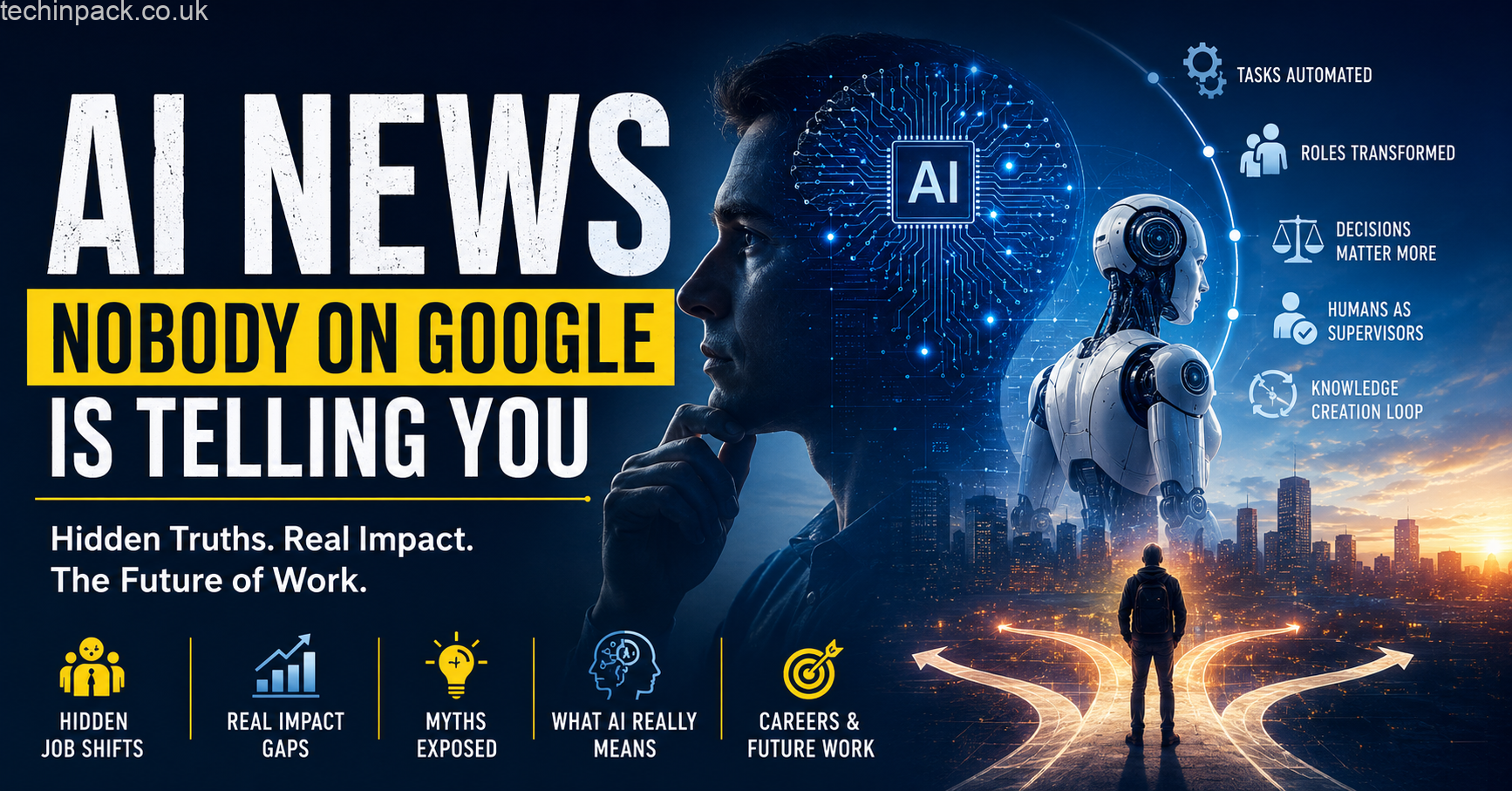
AI News has become one of the most searched topics in the world, with daily headlines about new models, billion-dollar investments, advanced chips, automation breakthroughs, and claims that “AI is changing everything.” However, the real problem is that most AI News content only explains what has happened, not what it actually means for your life.
Because of this, people often feel confused, overwhelmed, and uncertain about the future. In reality, they are not just searching for news updates they are searching for clarity, direction, and real understanding of how artificial intelligence will affect their jobs, skills, and everyday decisions.
Real Reason People Search AI News
On the surface, AI News looks like a purely technology-focused topic, but behind every search there is usually a deeper human question driving it. People are often wondering whether AI will replace their job, whether they should change their career path, if they are already falling behind, which AI updates actually matter to them, and whether what they are seeing is real progress or just hype.
This reveals a major gap in most AI content online. Google typically shows new AI tools, company announcements, model releases, and investment news, while users are actually looking for personal impact, career safety, skill direction, and future planning. This mismatch is the main reason AI News feels confusing — it is written like technical reporting, not like practical life guidance that helps people make real decisions.
Missing Reality Filter in AI News
One of the biggest problems in AI content today is that people treat everything as equally important, even though, in reality, AI updates vary greatly in impact. Some changes only affect research labs, some influence companies, some reshape entire job markets, and others are simply marketing announcements with little real-world effect.
However, most articles fail to classify or filter this information, which makes it difficult for readers to understand what actually matters. The missing system is simple: AI News should clearly explain whether something is short-term hype, a 1–2 year industry shift, or a long-term structural change. Without this kind of filtering, readers cannot properly judge importance, and everything starts to feel equally urgent, even when it is not.
Transformation of AI Evolution Stages
| Stage | Name | What AI Does | Real-World Meaning | What Most Content Covers |
| Stage 1 | AI as Assistant | Answers questions, helps write text, supports humans | Basic help tools for everyday users | Most Google content focuses here |
| Stage 2 | AI as Worker | Writes code, runs tasks, completes workflows | Automates individual work tasks | Widely covered in AI news |
| Stage 3 | AI as Autonomous System | Performs multi-step jobs, makes decisions, manages processes | AI starts operating like a semi-independent worker | Rarely explained clearly |
| Stage 4 | AI improving AI (Emerging) | Designs better AI systems, improves itself via feedback loops | AI accelerates its own development cycle | Almost missing in Google content |
Hidden Job Shift Nobody Explains Clearly
Most AI content says “AI will replace jobs,” but this is incomplete and often misleading because the real process is much slower and more structural. Instead of jobs disappearing suddenly, tasks are automated first, which gradually reduces the amount of human work required.
Over time, roles begin to shrink or merge, and people shift from creating work manually to supervising and managing AI-generated output. For example, a developer today may write less code by hand, spend more time reviewing AI-generated code, and focus more on system design rather than direct implementation. The missing explanation in most articles is that job loss is not a single event, but a gradual decomposition of tasks within roles.
Why AI Makes Companies Faster but Harder to Control
AI is improving productivity across industries, but an important detail is often missing from most explanations. While AI removes execution bottlenecks by writing code faster, generating research quickly, and automating complex analysis, it also creates a new and equally important bottleneck: human decision-making and verification. As a result, companies now face a different challenge where AI can produce work faster than humans can properly check or validate it.
This leads to overloaded review systems and makes the quality of decision-making far more critical than before. The key gap in most AI News coverage is that it focuses only on the increase in productivity, but does not clearly explain where the bottleneck actually shifts within organisations.
AI Can Be Wrong While Looking Right
One of the most dangerous hidden issues in AI systems is that AI outputs often appear correct even when they are not properly verified. This creates a serious challenge because humans cannot manually check everything AI produces, and in many cases the speed of AI output exceeds human verification ability. As a result, mistakes become harder to detect and may pass through systems unnoticed.
This leads to a growing concept often described as “plausible intelligence,” where AI generates responses that look accurate and convincing but may not always be fully correct. The key gap missing in most AI content is that reliability is not only about how accurate AI is, but also about the mismatch between AI speed and human ability to verify its outputs in real time.
AI Is Now Automating Knowledge Creation
Most people think AI only helps with tasks, but advanced systems are now going far beyond that role. They are designing experiments, testing hypotheses, improving workflows, and analysing complex research patterns.
This means AI is no longer just supporting work from the outside; it is beginning to enter the knowledge creation loop itself. This shift is important because it is no longer simple automation of manual tasks, but the automation of thinking processes inside research and development systems. The key gap in most Google content is that writers still describe AI mainly as a “tool”, whereas in reality it increasingly acts as a “research participant” that actively contributes to how knowledge is generated and refined.
Why AI News Feels Repetitive and Confusing
- Many users feel AI articles repeat the same information
- Most news sources mainly copy or repeat company announcements
- There is very little deep interpretation or explanation
- Structured impact analysis is usually missing
- Readers receive a lot of information but very little understanding
- This creates confusion despite high content availability
- AI News is often information-heavy but insight-poor
- The real gap is lack of meaning, context, and real-world relevance in reporting

Skill Devaluation Lag
One of the most important missing ideas in most AI discussions is that skills do not disappear instantly. Instead, they go through a gradual decline process over time. First, a skill still exists and people widely use it, but as AI systems improve, its value in the job market decreases. After that, fewer jobs require it, and eventually only advanced or specialised use-cases need it. For example, people still use basic coding, basic writing, and basic analysis, but their market value is slowly decreasing as AI takes over routine parts of these tasks.
The main gap in most articles is that they only talk about “job loss,” while ignoring the more important concept of skill value decay over time, which is a slower but more accurate way to understand real change.
Uneven Global AI Impact
AI adoption is not happening equally across the world. Some regions have advanced infrastructure, access to high-end compute power, and strong AI companies that allow them to adopt new technologies quickly. At the same time, other regions depend on imported systems, adopt AI much later, and have weaker digital infrastructure overall. This creates a major imbalance in how fast different economies benefit from AI.
The key missing insight in most content is that AI is not just transforming industries it is also increasing global economic speed inequality, where some countries move ahead much faster than others simply because they have better access to AI systems.
AI Control Problem
AI systems are advancing faster than the regulations and governance structures designed to control them. This creates serious unanswered questions that are often missing from mainstream AI discussions. For example, it is still unclear who will audit fully autonomous systems, who takes responsibility when AI makes critical decisions, and how organizations will detect or manage failures at large scale.The major gap in most content is that while AI capability is rapidly increasing, governance and control systems are not evolving at the same speed, creating a growing imbalance between what AI can do and what humans can effectively regulate or oversee.
AI Self-Improvement Feedback Loops
One of the most important but underexplained ideas in AI development is that AI systems can now help improve other AI systems. This creates a powerful feedback loop where a better model produces better data, which in turn helps train even better models, leading to faster and faster improvement over time.
The key reason this matters is that AI progress is no longer linear or steady; instead, it follows a compounding acceleration pattern where each improvement can speed up the next one. The main gap in most articles is that they describe AI progress as simple advancement, but they fail to explain the underlying feedback structure that is actually driving this rapid and self-reinforcing growth.
Infrastructure Limits Nobody Talks About
AI growth depends heavily on real-world physical systems that are often ignored in most discussions. These include electricity supply, advanced chips, data centre capacity, global supply chains, and geopolitical stability between countries that produce and control AI hardware. However, most AI content assumes that scaling is unlimited and will continue smoothly over time.
The missing assumption is that AI progress is not only driven by intelligence improvements, but also by physical and economic constraints that can slow down or reshape its growth. These limitations are rarely highlighted in mainstream AI News, even though they play a major role in how fast AI can actually expand.
Meaning of Work Crisis
If AI begins to handle most execution-based tasks, a deeper question emerges about what human value becomes in this new system. The remaining roles for humans may shift toward creativity, strategy, judgment, and supervision rather than direct task execution. This creates a deeper societal issue where work is no longer just about productivity, but increasingly tied to personal identity and purpose.
The key gap in most AI articles is that they rarely explore the psychological impact of losing traditional work identity, even though this may become one of the most significant long-term effects of AI-driven economies.
Why AI Benchmarks Don’t Reflect Real Life
AI performance is usually measured using controlled tests and benchmarks designed to evaluate specific capabilities. However, real-world environments are very different because tasks are messy, unpredictable, and constantly changing, often requiring human judgment and context awareness. The main gap in most AI discussions is that benchmarks measure performance in structured environments, not in real economic or workplace conditions. As a result, AI progress can appear more reliable or advanced in reports than it actually is when applied to real-life scenarios.
Biggest Hidden Shift
One of the most important but least discussed transformations in AI is the shift in control over work direction. At present, humans still decide what to build, which problems to solve, and which projects to prioritize.
However, AI systems are increasingly influencing these decisions by suggesting ideas, shaping workflows, and guiding outcomes. In the future, AI may have even greater influence over strategic direction itself. The final insight is that the most important shift is not about execution or productivity, but about control over what work actually means and how decisions are made in organizations.
Final Summary
AI News is not just about technology updates or new tools. It represents a deeper and quieter transformation happening inside economies and workplaces. Work is being broken down into smaller tasks and gradually automated by AI systems.
As this happens, humans are moving away from execution roles toward supervision and oversight. At the same time, verification becomes a major bottleneck, knowledge creation is increasingly automated, and decision-making processes are slowly being reshaped.