
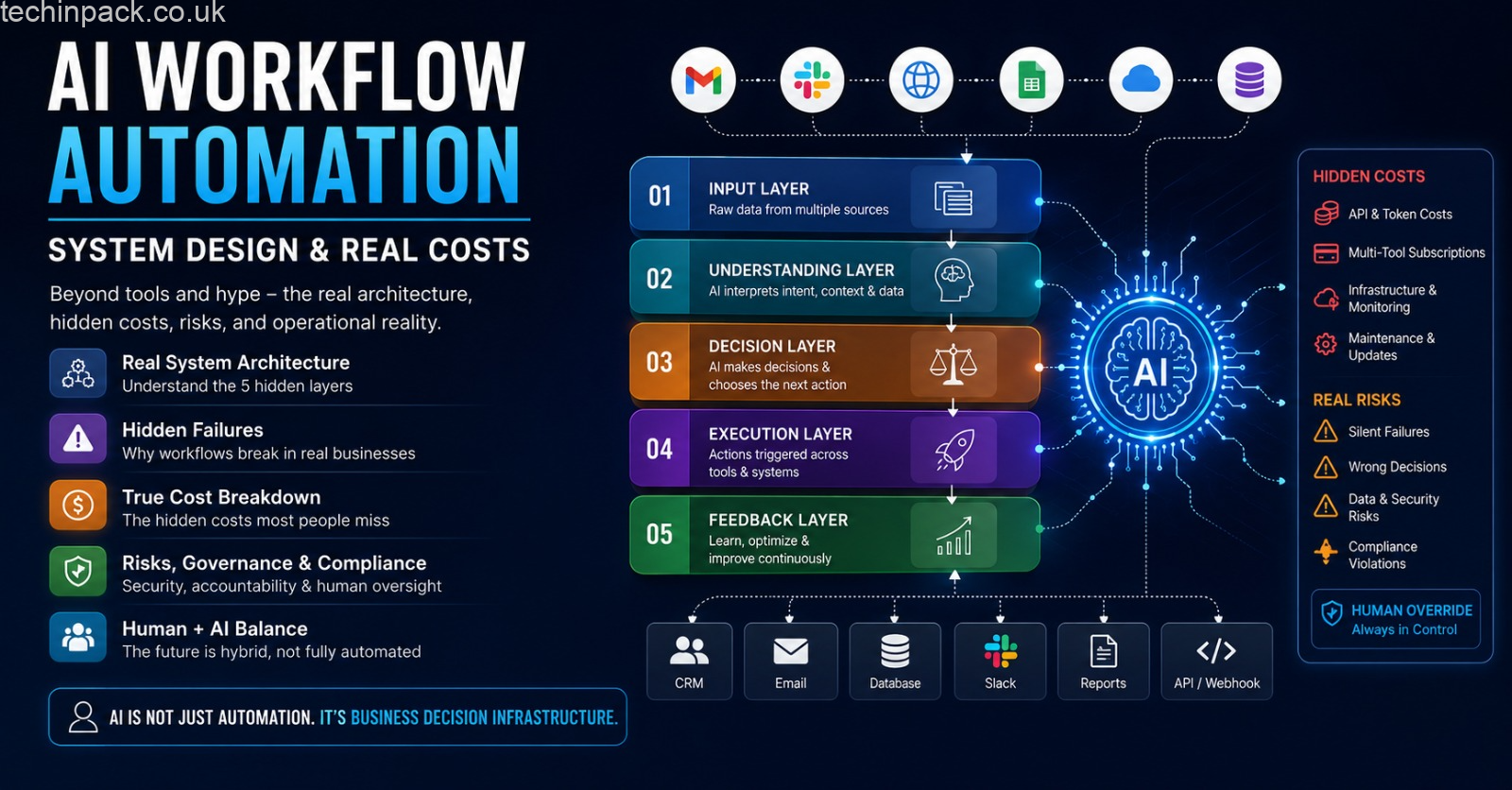
AI workflow automation is widely promoted as a simple way to improve productivity, reduce manual work, and connect tools with artificial intelligence. However, in real-world business environments, it behaves very differently from how it is usually described online.Most content on Google focuses on definitions, tools, and surface-level benefits. What is missing is the operational reality: systems break, costs scale unpredictably, AI makes incorrect decisions confidently, and workflows require continuous maintenance like software engineering systems.
In practice, AI workflow automation is less like a “set-and-forget productivity tool” and more like a living digital system that needs constant monitoring, correction, and redesign as business conditions change. It sits between human decision-making and software execution, so every weakness in data quality, API stability, or AI reasoning directly impacts business outcomes.
AI Workflow Automation Actually in Real Systems
In practice, AI workflow automation is a decision-driven execution system where AI does much more than just move data between tools. It interprets incoming information, understands intent and context, makes basic operational decisions, and then triggers the appropriate actions across multiple applications. It can also coordinate multi-step business processes where different tools, APIs, and systems must work together in a specific sequence.
The key insight that most articles overlook is that AI workflow automation does not only automate tasks it automates decision steps inside workflows. Instead of simply replacing manual work, it replaces parts of the thinking process that humans normally perform during execution, such as deciding what action should happen next or which system should be used.
Hidden 5 Layer of AI Workflow Automation
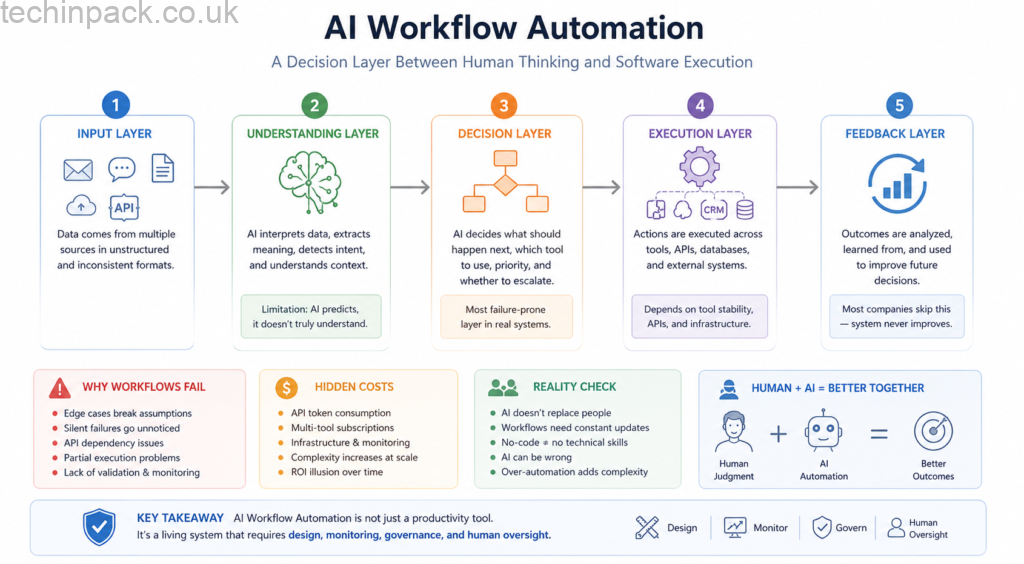
Most blogs show workflows as simple tool connections. In reality, every system has five hidden layers.
Input Layer
The input layer is the starting point of any AI workflow automation system, where data is collected from multiple sources such as emails, online forms, customer chats, APIs, and internal documents. However, the biggest challenge at this stage is that the data is rarely clean or structured. In most real business environments, information is incomplete, inconsistent, duplicated, or unformatted, which creates immediate complexity for downstream AI processing and increases the chances of incorrect interpretation later in the workflow.
Understanding Layer
In the understanding layer, AI attempts to interpret the incoming data by extracting meaning, identifying intent, classifying urgency, and understanding context. While this may seem intelligent, the limitation is that AI does not truly “understand” information like a human. Instead, it relies on pattern prediction based on training data, which means it can misinterpret unusual, ambiguous, or new types of inputs that its training distribution did not well represent.
Decision Layer
The decision layer is the most important yet least discussed part of AI workflow automation because it determines what action should happen next, whether the system should automate a task or escalate it to a human, which tool should trigger, and how to assign priority. Despite its importance, this layer is also the most failure-prone because of unclear instructions, missing context, conflicting logic rules, and unpredictable AI outputs. In real-world systems, most automation breakdowns originate at this stage because even small decision errors can cascade into larger workflow failures.
Execution Layer
The execution layer is where the actual actions take place, such as updating CRM systems, sending emails, modifying databases, or triggering API calls across connected tools. Although this stage appears straightforward, it still carries significant risk because even when the AI makes the correct decision, external systems can fail due to API downtime, authentication errors, rate limits, or integration issues. This makes execution reliability dependent not only on AI accuracy but also on the stability of the entire connected infrastructure.
Feedback Layer
The feedback layer is designed to improve system performance by learning from outcomes, refining decisions, and adjusting workflows based on past success or failure. In advanced AI systems, this layer is essential for long-term adaptability and continuous improvement. However, in reality, most companies do not implement proper feedback loops, which means their automation systems remain static instead of evolving. Without feedback, errors repeat over time, and the system cannot improve its decision quality, leading to long-term inefficiency and hidden operational risk.
Why AI Workflow Automation Fails in Real Businesses
Despite marketing claims, failure is common and often invisible.
Edge Case Breakdown Problem
AI workflows often fail because they are designed for predictable patterns, but real-world business data rarely behaves in a structured way. Small changes in input format, unexpected user behaviour, missing fields, or unfamiliar language can all break assumptions made by the system. In practice, most business data is not clean or standardised—it is full of edge cases that fall outside normal patterns, which is why AI systems struggle to maintain consistent performance in real operational environments.
Silent Failure Problem
One of the most dangerous issues in AI workflow automation is silent failure, where the system shows a “success” status even though the outcome is incorrect. For example, it may send the wrong email, update the wrong CRM record, misclassify a customer request, or execute an incorrect decision without any alert. The core problem is the lack of proper validation layers that check whether the output is actually correct, meaning errors can go completely unnoticed while still affecting business operations.
API Dependency Failure
AI workflow automation systems are heavily dependent on external APIs, which makes them vulnerable to instability outside their control. Workflows can break due to API updates, authentication failures, rate limits, or service downtime. Since most workflows rely on multiple connected services, a single API failure can disrupt multiple processes at once, creating a chain reaction of broken automations across the system.
Partial Execution Failure
Partial execution failure occurs when a workflow completes only part of its intended process, such as finishing step one, failing at step two, and skipping step three, while still reporting a successful run. This creates serious operational risks, including corrupted data, inconsistent records, and hidden system errors. Because the system does not always flag incomplete execution as a failure, these issues often remain unnoticed until they begin affecting downstream processes.
Hidden Cost Structure of AI Workflow Automation
Most guides say automation saves money. In reality, cost increases at scale.
API Token Consumption Costs
Every action inside an AI workflow can generate multiple API calls, and each of these calls has a direct cost attached to it. Tasks such as classification, summarisation, decision-making, and content generation all consume tokens, meaning a single workflow often triggers several paid AI operations in sequence. As a result, what appears to be a simple automated process can quietly turn into a continuous cost engine, especially when workflows run frequently or at scale.
Multi-Tool Subscription Stacking
In real-world implementations, AI workflow systems rarely rely on a single tool. Instead, they combine multiple platforms such as automation tools (Zapier, Make, or n8n), AI APIs (OpenAI, Claude, or Gemini), CRMs, and databases. Each of these services comes with its own subscription or usage-based pricing, which leads to stacked recurring costs. Over time, this multi-tool dependency significantly increases the total operational expense of maintaining an AI-driven automation system.
Hidden Infrastructure Costs
Beyond the obvious software and API expenses, there are several hidden infrastructure costs that are often overlooked. These include logging systems for tracking workflow activity, monitoring tools for performance and error detection, debugging infrastructure for fixing failures, and data storage for maintaining workflow history. Although these components are essential for stability and scalability, they add continuous overhead that is rarely considered during initial planning.
ROI Illusion Problem
At the early stage of implementation, AI workflow automation often appears highly cost-effective because it reduces manual labour and speeds up processes. However, as the system scales, the complexity and cost of maintaining workflows increase significantly. What initially looks like a low-cost efficiency upgrade can evolve into an expensive and complex infrastructure system, creating an “ROI illusion” where perceived savings reduce or even reverse over time.
Myths vs Reality in AI Workflow Automation
- Myth AI replaces employees
Reality AI mainly automates repetitive micro-tasks, not entire jobs. Humans are still needed for judgment, creativity, and decision-making, while new roles like AI workflow designers and automation specialists are emerging. - Myth Workflows run forever once built
Reality AI workflows need constant updates because APIs, business rules, and AI models change over time. - Myth No-code means no technical skills
Reality You still need logical thinking, system design, and understanding of data and APIs. - Myth AI guarantees accuracy
Reality AI improves speed but can still make wrong decisions, so human checks are essential. - Myth More automation always means better efficiency
Reality Over-automation can increase complexity and reduce control, making systems harder to manage.
Scaling Problems in AI Workflow Automation
As AI workflow automation scales, organisations often face challenges that basic guides rarely discuss. More workflows create complex dependency chains that are difficult to manage, API rate limits can slow down or disrupt operations, teams may unknowingly build duplicate automations that cause confusion and inefficiency, and large workflow environments become harder to monitor, maintain, and optimise.
As a result, scaling automation is not just about handling more tasks it also requires managing growing complexity across the entire system.
Real World Hybrid Stack Architecture
In real-world enterprise environments, AI workflow automation is rarely built on a single platform. Instead, organisations typically use a multi-layer stack where trigger tools such as Zapier or Make detect events, logic engines like n8n manage workflow rules, AI models provide reasoning and decision-making, and CRMs or databases store and process business data.
This layered architecture allows companies to combine the strengths of different technologies rather than relying on one tool to handle everything. It also provides greater flexibility, scalability, and resilience when workflows become more complex. The key insight is that successful AI automation systems are usually ecosystems of interconnected components, not standalone applications.
Human vs AI Responsibility Gap
One of the biggest challenges in AI workflow automation is governance and accountability. When an AI system makes an incorrect decision, it is often unclear who is responsible the software provider, the workflow designer, the business team, or the organisation itself.
This issue becomes particularly serious in high-risk areas such as finance, human resources, legal operations, and customer escalation processes, where a single incorrect decision can have significant financial, legal, or reputational consequences. Another major weakness is the lack of proper human oversight mechanisms. Many automated workflows execute actions without approval checkpoints, escalation routes, or manual override options, which makes it difficult for humans to intervene when something goes wrong.
Debugging & Maintenance Reality
We should view AI workflows as software systems rather than static automation tools because they require continuous maintenance and optimisation to remain reliable. Unlike traditional automation, AI-driven workflows operate in constantly changing environments where APIs get updated, AI models evolve, and business rules change over time. These changes create a continuous breakdown cycle that can cause workflows to malfunction unexpectedly.
The complexity increases further when multiple integrations, AI models, and decision layers come into play.
Additionally, many organisations lack proper version control and rollback mechanisms for their workflows, making it difficult to restore previous working configurations when errors occur.
Security & Compliance Risks
Security and compliance remain some of the most overlooked risks in AI workflow automation. As data moves between multiple applications, APIs, and cloud services, the risk of data leakage increases, especially when connected systems share sensitive information without proper controls.
Misconfigured workflows can also expose API credentials, authentication tokens, or access keys, creating serious security vulnerabilities. In multi-tool environments, a single weak integration can become an entry point that compromises the entire automation ecosystem, creating what people often call a vulnerability chain. Beyond security concerns, organisations also face compliance blind spots, where automated decisions or actions may unintentionally violate industry regulations, privacy requirements, or internal governance policies without detec
Human AI Balance
One of the most important questions in AI workflow automation is whether AI should execute actions independently or simply recommend them for human review. While fully autonomous systems can increase speed and reduce manual effort, they also introduce higher risks when incorrect decisions occur.
For this reason, many organisations follow a safer approach where AI suggests actions, identifies patterns, and provides recommendations, while humans retain responsibility for approving critical decisions, especially in areas such as finance, legal operations, HR, and customer management. Real-world experience shows that fully automated systems often become fragile over time because they struggle with exceptions, changing business conditions, and unexpected scenarios.
Real Use Cases
People widely use AI workflow automation in customer support, IT operations, and sales, but it still requires human oversight. In customer support, AI classifies tickets, drafts replies, and routes requests, but humans handle complex or sensitive cases. In IT operations, it automates tasks like password resets, provisioning, and monitoring, yet governance is essential to avoid errors and security issues.
Sales, AI helps with CRM updates, lead scoring, and message generation, but humans are still responsible for relationship building and closing deals. Overall, AI improves speed and efficiency, but critical decisions remain human-led in most real-world systems.
Future of AI Workflow Automation
AI workflow automation is gradually evolving beyond simple task automation into more advanced “business decision automation systems.” Instead of only performing repetitive actions, modern AI workflows are starting to handle decision routing, where they select different paths based on context and data.
They are also becoming predictive workflows that anticipate outcomes and trigger actions before issues occur. In more advanced setups, these systems function as semi-autonomous execution networks, where AI can coordinate multiple steps across tools with minimal human input. This shift shows that AI no longer just supports work—it is beginning to participate in how business processes make decisions.
Final Thoughts
AI workflow automation is not just a productivity tool, but a business decision system layer that sits between human thinking and software execution. Instead of simply speeding up tasks, it influences how systems make and carry out decisions. Its real success does not depend on the tools used, but on how well people design and govern the system.
Factors such as architecture design, failure handling, cost control, governance structure, and human override mechanisms determine whether the automation remains reliable and scalable.